
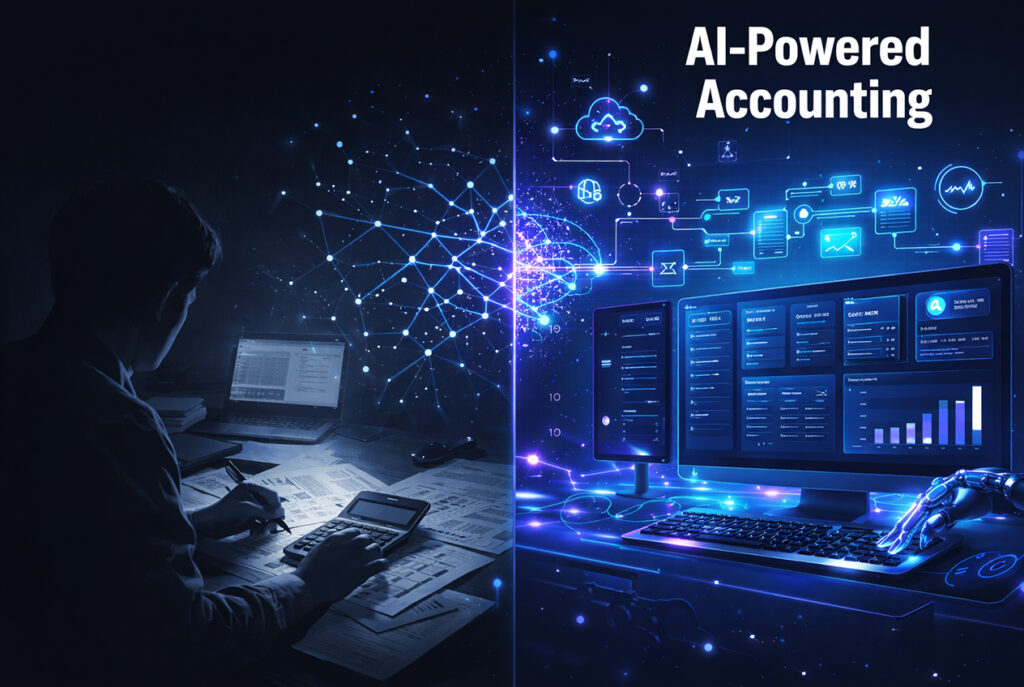

In the world of corporate finance, we are witnessing a “Fourth Industrial Revolution.” For decades, accounting was a labor-intensive, backward-looking function. Today, Artificial Intelligence (AI) and Robotic Process Automation (RPA) are shifting the “efficiency frontier,” moving the accountant from the back office to the boardroom as a strategic co-pilot.
From “Data Entry” to “Data Interpretation” The most immediate impact of AI is the elimination of manual “grunt work.” Optical Character Recognition (OCR) combined with Machine Learning (ML) can now read, categorize, and code thousands of invoices with 99.9% accuracy in seconds. This isn’t just a marginal gain; it’s a structural transformation. It allows a business to maintain “Continuous Accounting”—where the books are essentially closed every day, providing a real-time view of the company’s financial health.
Anomaly Detection and Fraud Prevention From an audit perspective, AI is a game-changer. Traditional auditing relies on “sampling”—looking at a small percentage of transactions to infer the health of the whole. AI, however, can analyze 100% of a company’s transactions in real-time. Algorithms can identify “outliers” or patterns of behavior that suggest fraud, duplicate payments, or compliance breaches long before a human auditor would spot them. This moves the finance function from a “detective” role to a “preventative” one.
Predictive Analytics: The MBA’s Secret Weapon While traditional accounting tells you what happened last month, AI-driven accounting tells you what will happen next month. By analyzing historical cash flow patterns, market trends, and even external economic data, AI can provide highly accurate cash flow forecasts. For an MBA-trained leader, this data is gold; it allows for better decision-making regarding capital expenditure, hiring, and inventory management.
The Rise of the “Augmented Accountant” The fear that AI will replace accountants is misplaced. Instead, it is “augmenting” them. By automating the routine, accountants are freed to perform high-value tasks: tax strategy, M&A due diligence, and performance consulting. The future belongs to the “T-shaped” professional—one who has deep technical accounting knowledge (CA/CPA) and broad strategic business acumen (MBA), powered by a sophisticated tech stack.