
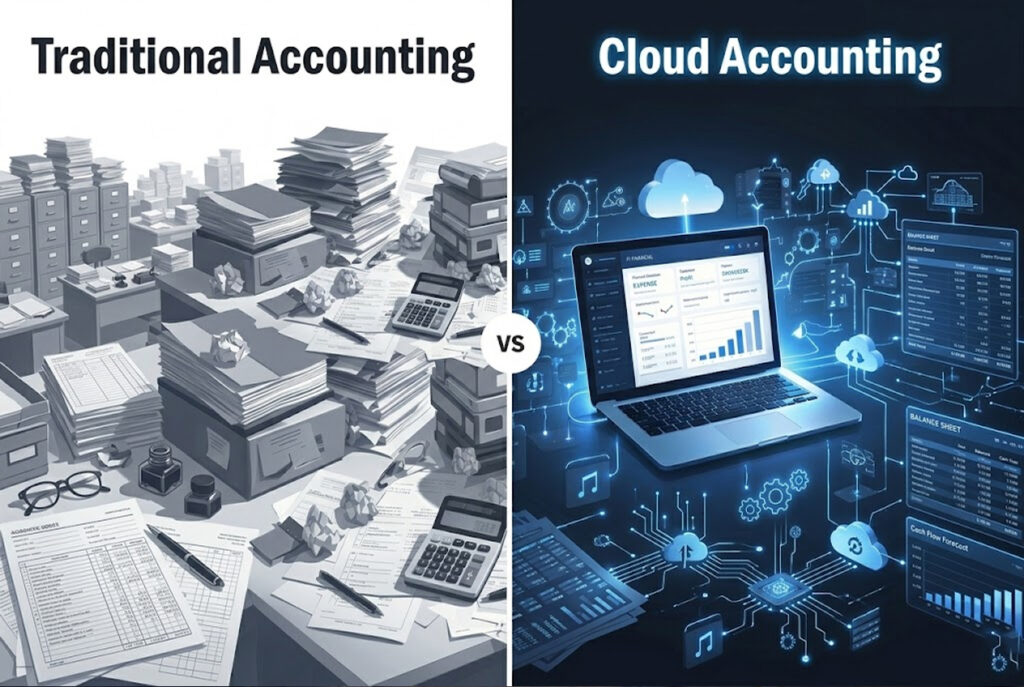

The debate between Cloud and Traditional accounting is no longer a matter of preference; it is a matter of Survival and Competitive Advantage. As we move toward a real-time global economy, the limitations of “Desktop/Server-based” accounting are becoming strategic liabilities.
The Fallacy of “Local Security” Traditionalists often argue that having data on a local server is “safer.” As a CPA, I can confirm the opposite is true. Local servers are vulnerable to physical theft, fire, hardware failure, and—most commonly—unpatched cyber-vulnerabilities. Cloud providers like Xero, QuickBooks Online, or NetSuite spend billions on bank-grade encryption, multi-factor authentication, and geo-redundant backups that no SME could afford on their own.
Real-Time Data vs. Historical Artifacts Traditional accounting is “Post-Facto.” You bring your receipts to an accountant at the end of the month, and they give you reports two weeks later. You are making decisions based on 45-day-old data. Cloud accounting allows for Real-Time Bank Feeds. You can see your cash position, pending bills, and sales performance this morning. This agility allows for “Pivoting,” which is the hallmark of successful modern enterprises.
The Ecosystem Advantage (The API Economy) Cloud accounting software does not exist in a vacuum. It acts as the “Operating System” for your business. Through APIs, your accounting software can “talk” to your CRM (Salesforce), your E-commerce platform (Shopify), and your Payroll (Gusto). This eliminates manual data entry, which is the primary source of human error. In a traditional setup, data must be manually exported and imported, creating “Data Silos” that lead to conflicting versions of the truth.
Global Collaboration and The Borderless Office In the post-pandemic “Work from Anywhere” era, the cloud is the only way to maintain a distributed finance team. A founder can be in London, the outsourced accounting team in India, and the auditor in New York—all looking at the same “Single Source of Truth” simultaneously. This transparency builds trust with investors and ensures that the books are always “Audit-Ready.”