
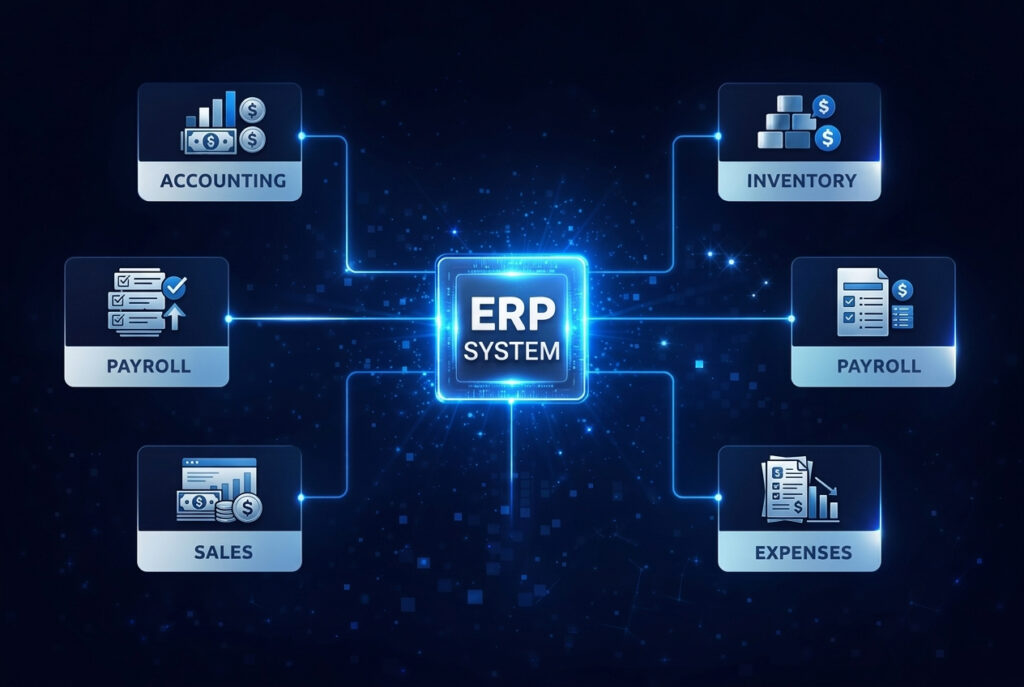

As a business scales beyond the “SME” stage, fragmented software (using one tool for sales, another for payroll, and another for accounting) becomes a liability. This is where an Enterprise Resource Planning (ERP) system becomes essential. An ERP is the “Central Nervous System” of an organization, integrating every department into a single, unified database.
Eliminating “Information Silos” The primary pain point in growing companies is that the “Sales Team” sees one set of numbers, while the “Finance Team” sees another. An ERP eliminates these silos. When a sales contract is signed, the project is created, the resources are allocated, and the revenue recognition schedule is set in one unified flow. This “Single Source of Truth” ensures that everyone in the organization is working from the same data, reducing internal friction and improving executive decision-making.
Enhanced Internal Controls and Auditability For a CA/CPA, the beauty of an ERP lies in its “Audit Trail.” Every transaction is tracked from inception to completion. Who authorized the purchase order? When was the invoice received? Who approved the payment? In a modular ERP like NetSuite, SAP, or Microsoft Dynamics, these controls are “baked into” the system. This makes the annual audit significantly smoother and less expensive, as the auditors can verify the “Systemic Controls” rather than testing thousands of individual transactions.
Optimized Working Capital Management ERPs provide a holistic view of the “Cash Conversion Cycle.” By integrating inventory management with accounts payable and receivable, an ERP can tell you exactly how much cash is “trapped” in the warehouse. For an MBA, this is the key to improving “Return on Capital Employed” (ROCE). You can optimize stock levels based on real-time demand, ensuring you aren’t over-leveraged in slow-moving inventory.Scalability for Global Operations If your business expands into multiple countries, an ERP handles multi-currency, multi-language, and multi-tax-jurisdiction requirements effortlessly. It can perform “Inter-company Eliminations” and “Consolidated Financial Reporting” at the click of a button—tasks that would take an in-house team weeks to perform manually in Excel.