
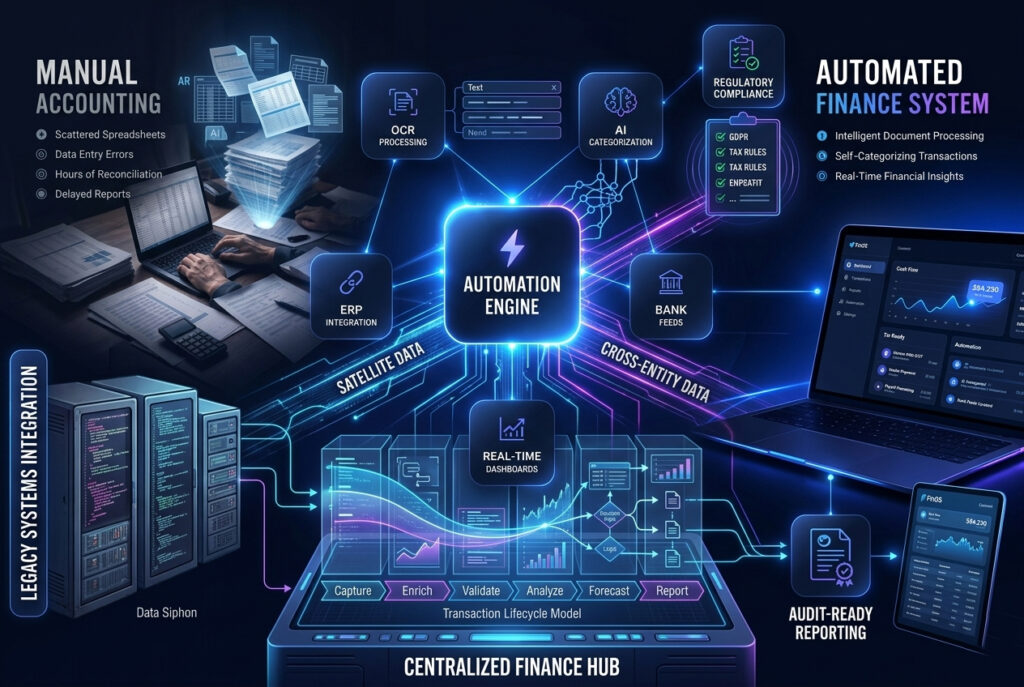

Automation is no longer a luxury; it is a “Baseline Requirement” for operational efficiency. However, “Blind Automation” can be dangerous. A strategic approach to accounting automation involves identifying the highest-ROI tasks and implementing a “Human-in-the-Loop” (HITL) framework to ensure accuracy and governance.
The Hierarchy of Automation: AP, AR, and Reconciliation
- Accounts Payable (AP): Tools like Bill.com or Tipalti use AI-driven OCR to read invoices and route them for approval. This can reduce the cost of processing an invoice by up to 80%.
- Accounts Receivable (AR): Automation tools like Chaser or Tesorio send intelligent, polite follow-ups to debtors based on their payment history, significantly reducing “Days Sales Outstanding” (DSO).
- Reconciliation: Modern accounting platforms use “Rule-Based Matching” to automatically pair bank transactions with ledger entries.
Best Practice: The “Rule of Three” in Implementation When deploying automation, we follow a three-step strategic framework:
- Standardize: You cannot automate a “mess.” First, simplify your Chart of Accounts and your approval workflows.
- Optimize: Identify where the bottlenecks are. Is it in invoice approval? Is it in expense reimbursement?
- Automate: Only then do you deploy the software. Automating a bad process only makes the bad process happen faster.
The “Human-in-the-Loop” (HITL) Principle As a CPA, I emphasize that automation should handle the processing, but humans must handle the judgment. For example, AI can categorize an expense, but a human must review high-value or unusual transactions. “Exceptions Management” is the key best practice here—the system handles 95% of routine tasks, and the finance professional focuses only on the 5% of “exceptions” that require professional judgment.Cybersecurity and “Bot Governance” As you automate, you create new risks. “Automated Clearing House” (ACH) fraud is a rising threat. Best practices include implementing “Multi-Factor Authentication” (MFA) for all payment approvals and ensuring that your automation tools have strict “Role-Based Access Controls” (RBAC).