
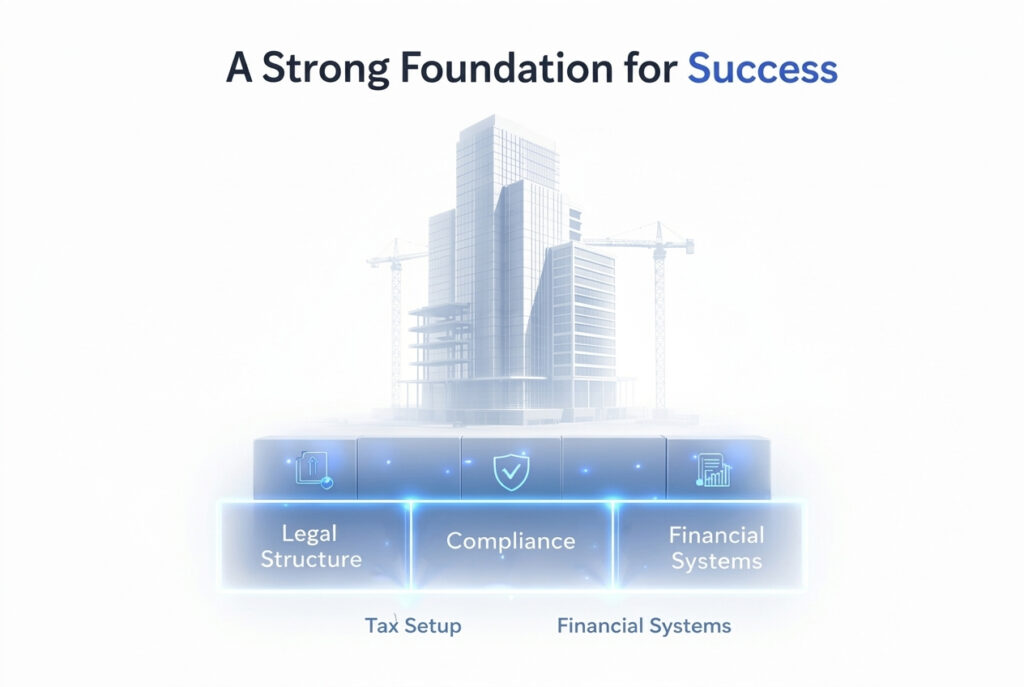

Starting a business is an exercise in “Risk Engineering.” From an MBA perspective, you are building a scalable engine; from a legal/financial perspective, you are building a protective fortress. The decisions made in the first 90 days—structure, equity, and IP—will determine the company’s ability to raise capital or exit five years down the line.
The “Entity Selection” Matrix: Liability vs. Tax Efficiency The choice between a Sole Proprietorship, an LLP, or a Private Limited Company is not just about registration fees. It is a trade-off between “Operational Simplicity” and “Capital Scalability.”
- LLP: Ideal for professional services; offers limited liability with lower compliance costs.
- Private Limited: The “gold standard” for startups seeking VC funding. It allows for equity dilution, employee stock options (ESOPs), and has a distinct legal personality that survives its founders. Choosing the wrong structure early on can lead to “Conversion Costs” later that are ten times the original setup fee.
The “Founders’ Agreement”: Pre-empting the “Deadlock” Many startups fail not because of the market, but because of founder disputes. A strategic founder’s agreement covers “Vesting Schedules” (ensuring founders earn their equity over 4 years), “Buy-Sell Provisions” (what happens if someone leaves?), and “Drag-along/Tag-along” rights. From a financial standpoint, this ensures the “Capital Table” remains clean and attractive to future investors.
Intellectual Property (IP) Seeding One of the biggest legal oversights is “IP Leakage.” If a founder develops code or a brand before the company is incorporated, the company doesn’t technically own it. A “Technology Assignment Agreement” is essential to transfer all IP from the individuals to the corporate entity. Without this, your “Balance Sheet” is missing its most valuable intangible asset, making the company un-investable.Capitalization and “Thin Capitalization” Rules How you fund the business—Debt vs. Equity—matters. While debt provides tax-deductible interest, “Thin Capitalization” rules in many jurisdictions prevent companies from being overly debt-heavy to shift profits. An MBA-trained CFO balances the “Cost of Capital” to ensure the firm has enough “Runway” without tripping over debt-covenants or regulatory ceilings.