
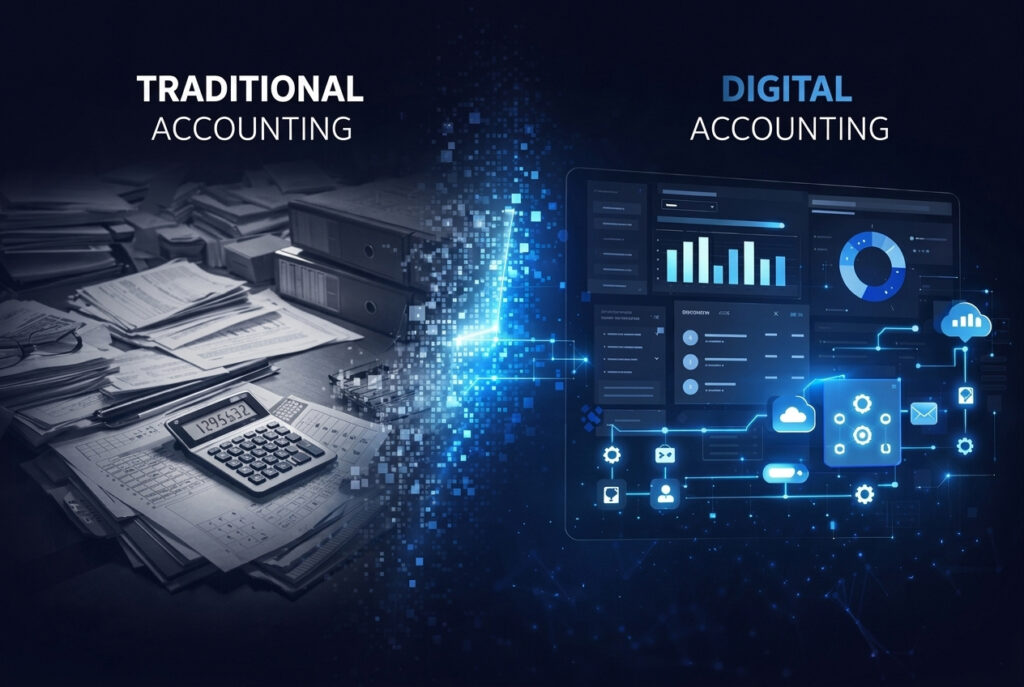

Digital Transformation (DX) is often misunderstood as merely “going paperless.” In the accounting world, DX represents a fundamental shift in the “Financial Supply Chain.” It is the transition from a manual, linear process to an integrated, data-rich ecosystem where financial data is used for “Real-Time Intelligence” rather than just “Historical Reporting.”
The End of the “Month-End Close” In a traditional setup, the “Closing of the Books” is a frantic, two-week period following the month-end. Through digital transformation, we move toward “Continuous Accounting.” Cloud-based ledgers, integrated with bank feeds and inventory systems, allow for daily reconciliations. For a CEO, this means having a real-time dashboard of their EBITDA and Cash Position on the 5th of the month, not the 25th. This speed is a significant competitive advantage in fast-moving markets.
The API Economy and Data Interoperability Modern accounting software acts as a “hub” connected to various “spokes”—CRM, E-commerce, HRIS, and Inventory Management. Through APIs (Application Programming Interfaces), data flows seamlessly between these systems. When a sale happens on Shopify, the inventory is adjusted, the tax is calculated, and the journal entry is posted automatically. This “Zero-Touch” accounting eliminates the human error inherent in manual data entry and ensures that the “Sub-Ledgers” always match the “General Ledger.”
Data as a Strategic Asset A well-read MBA knows that “Data is the new oil.” Digital transformation turns “Invoices” into “Data Points.” By applying Big Data analytics to your accounts payable and receivable, you can identify patterns: Which vendors offer the best early-payment discounts? Which customers are consistently late? Digital accounting allows for “Predictive Modeling,” enabling the finance team to forecast future cash flows with 95%+ accuracy based on historical behavioral data.The Cultural Shift: The “Digital-First” Finance Team The biggest hurdle to DX isn’t the software; it’s the mindset. A digitally transformed accounting department moves away from “Transaction Processing” and toward “Decision Support.” The role of the accountant shifts from a “gatekeeper” to an “analyst” who uses digital tools to provide strategic insights that drive growth, cost-efficiency, and risk mitigation.